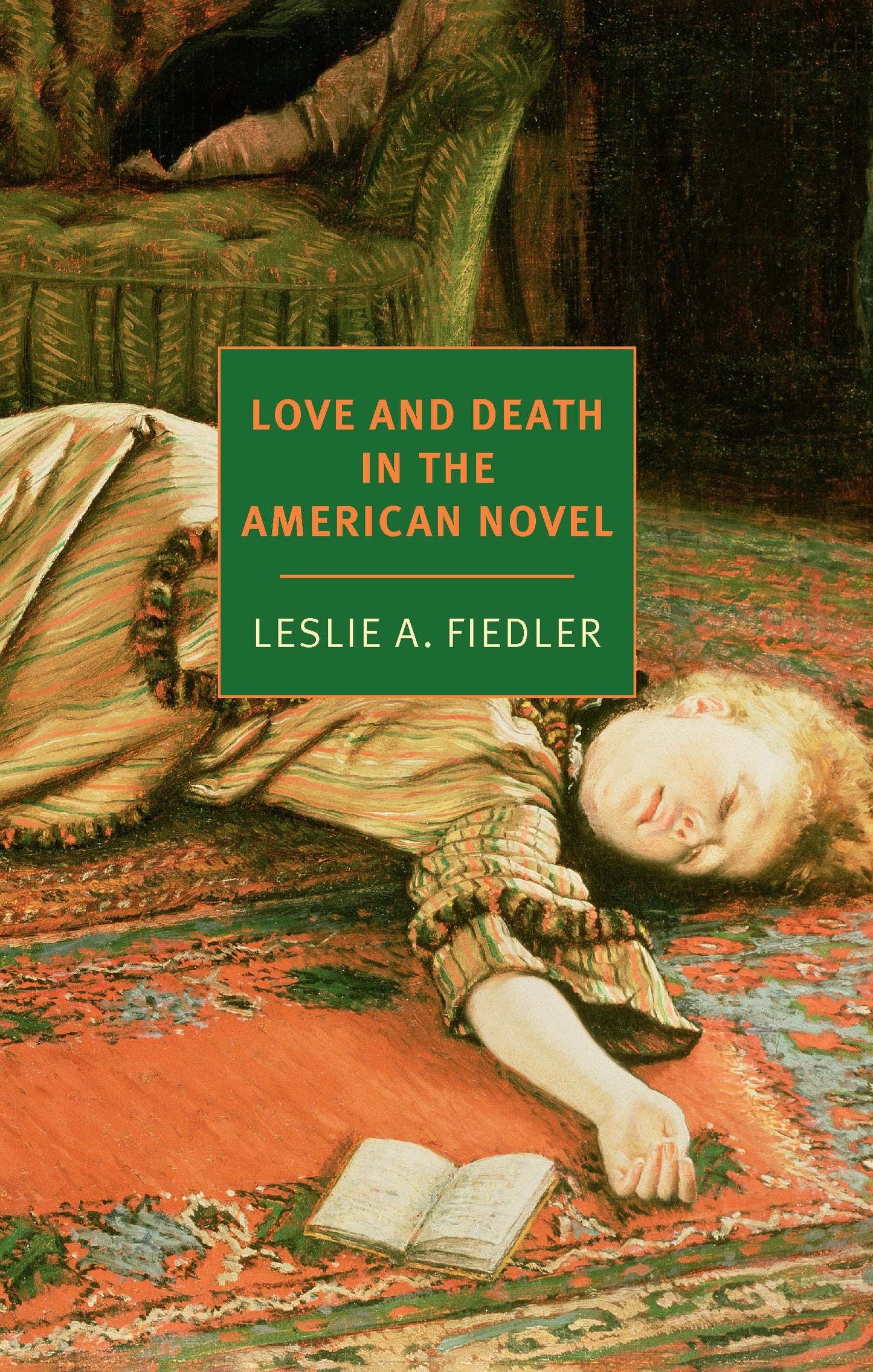
Leslie Fiedler's Love and Death in the American Novel is one of the greatest books ever written about American literature. It makes some provocative assertions, true, but more than anything, it's this high-velocity voice-driven exploration of what makes American literature itself. And Fiedler is pound for pound just one of the most incredible stylists we've ever seen. It's a book that provoked me and challenged me and taught me how to think deeper and sharper and better and bolder in language. A stunning book.
—Brandon Taylor
[Love and Death] is an incredible repository of vexations, bafflements, witticisms, and brilliancies. Ostensibly a history of American fiction from 1789 to 1959, it is in fact 'a kind of gothic novel,' as Fiedler described it, with a quick pulse and a wry, expansive style . . . It is a polemical, spirited salvo that never pretends to be a work of dispassionate social science. Its tone is decisive, but it speaks with the imperious authority of taste, not the desiccated one of surveys and statistics . . . 'I have, I admit, a low tolerance for detached chronicling and cool analysis,' [Fiedler] once confessed in a review. 'I long for the raised voice, the howl of rage or love.' And, in Love and Death, how he howls!
—Becca Rothfeld, The New Yorker
[Love and Death] is a tour de force of literary criticism—strange, ecstatic, a kind of séance . . . Rereading it all these decades later, I felt Fiedler’s book light up nearly all the lights in my internal pinball machine . . . It reinstalled nodes in my understanding of our fictional origins. But this time around I loved it mostly as an outrageous and iconoclastic piece of rhetoric, nearly novelistic in its scope.
—Dwight Garner, The New York Times
Fiedler [wrote] many spectacular pages on some of our most legendary novelists, among them Hawthorne, Melville, and Twain . . . the depth and breadth of [Love and Death's] erudition—it seemed to trace the development of novels from the beginning of time—was in itself a marvel; and then there was its sheer readability . . . [though] its tone is uniformly aggressive, most of its sentences, unlike those in academic writing, go down like ice cream.
—Vivian Gornick, The Nation
[Love and Death in the American Novel] is an exemplary work of mid-century criticism: cheerfully unacademic, heedless of boundaries between periods or disciplines, full of virtuosic arguments . . . Throughout, Fiedler holds forth like the perfect guest at a contentious dinner party, aiming to shock but in sincere belief of every word he says. Few people today titillate in such good faith; few people care, as Fiedler did, about the intellectual tenor of a provocation.
—Zoe Hu, The Baffler
One of the great, essential books on the American imagination . . . an accepted major work.
—The New Yorker
Prof. Fiedler's entertaining account of the American novel's obsessions remains one of the key works of American studies.
—Publishers Weekly
Genuinely original . . . a work of lasting importance . . . a powerful indictment of our culture and of modern culture in general.
—Richard Chase
I know few works of criticism that are so likely to involve the reader whose interest in literature is not of a professional kind . . . it amounts to a general cultural history of the nation.
—Lionel Trilling
In its insights the book remains immensely intelligent, immediate, and vital.
—David Plante, Bookforum
It is not possible to read Leslie Fiedler's criticism without a sense of awe and excitement.
—Los Angeles Times
Dr. Fiedler's witty, exasperating, energetic, penetrating book will prove indispensable...a high level of scholarship and intelligence.
—The Specator
Something of a classic...witty and arresting...[Fiedler] has contrived to make the Americana heritage less wholesome, but far more interesting than once seemed likely.
—Encounter